A battle is resolved at every hourly update, for every squadron attacking on site. There is always randomness: two identical attacks never give the same result. Here is what you need to read a report — and to win.
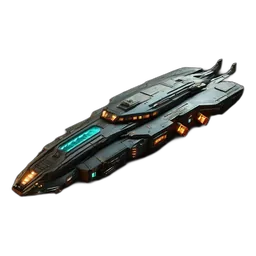
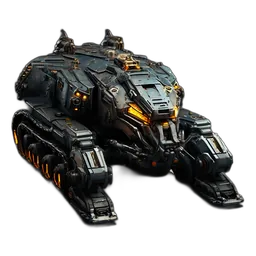
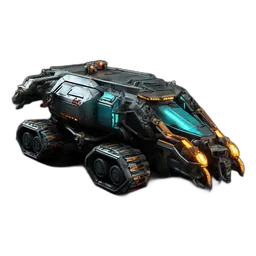

Forces
For each side, the game adds up the attack and defence of every unit present — attackers and defenders can be several players — applying each owner's research levels (+10% per level). Troops at the base defend automatically.
Two phases
- The space phase: both sides' ships and the defender's stations. Stations engage first. At home, your transports do not take off: they stay at the spaceport, out of the fight, and cannot be lost. The attacker's transports carry the troops: they fly, and they can fall.
- The ground phase, only if the attacker still has at least one transport: the carried units against all of the defender's robots, soldiers and special units. Shelters only hold inhabitants.
Losses
Losses follow Lanchester's square law: each side loses at the rate of the attack still standing against it. The weaker side melts, and the more it melts the less harm it does; an army's strength therefore grows with the square of its numbers — twice the units, four times the strength. With equal forces, each loses about 35% per hour. A fleet that fires breaks off at 50% of the hour's losses. An attacker that breaks off leaves orbit without landing; a defender that breaks off does not leave its planet: it pulls back for the hour and fights again the next hour, as long as the attacker is there. A ground garrison fights to the end, and unescorted transports cannot escape a fleet. In an interception, an intercepted fleet that breaks off flies on with what it has left.
Losses are not spread evenly: fragile units fall faster than armoured ones (a combat ship loses two to three times more than a frigate), and transports are relatively spared — as they have been since the December 2005 rework. If a transport falls, everything it carried falls with it.
Cannon and shield
An active planetary cannon adds 3% losses per hour to attacking ships. The shield cuts the defender's losses by 25%.
Special effects
Computed on the survivors of the ground phase:
- Stolen population: up to 5% of the target's unsheltered population, depending on the ground balance of power.
- Holding the ground: if attackers are still standing and their attack exceeds the defence left against them, their robots and soldiers loot 1 vitarium, 0.5 energy and 0.5 food each (at most 5% of stocks) every hour on site. On the landing hour only, they also tear down one building per 3,000 attack points: the assault breaks things, the occupation loots. The building is drawn at random among all your buildings: a single one among a hundred others has one chance in a hundred to fall.
- Annihilator: 50 surviving annihilators destroy one building per hour (45 at level 2, 40 at level 3…). Never shelters first. All together, attackers tear down no more than 3% of the buildings per hour.
- Harvester: each steals 30 vitarium, 15 energy and 15 food per hour, capped at 10% of the target's stock.
- Loot travels in the transports: what is looted each hour is loaded into the squadron's transports and only reaches your stocks when it returns. Each transport carries an equal share of the loot, and a sunk transport loses its own. Sunk over the looted planet, its share goes back to it. Sunk by an interceptor in open space, its share is taken by the interceptor if it has a transport of its own to carry it and has not fled; otherwise the rest of the convoy recovers it, or it is lost.
- Protecting a convoy: a squadron can return with another of your squadrons sent to the same planet — whichever finishes its stay first waits for the other on site, then they return together and fight together if intercepted. A squadron can also escort the return of one of your squadrons or an ally's: it joins it in flight, stays with it until it lands, and fights at its side. The loot stays with the convoy.
- Deviator: 10 surviving deviators convert one enemy robot or soldier per hour, capped at 5% of the target army.
The battle report
It is written into the history of both sides and every participant, in the original format: each player's research levels; for each unit type, quantity, losses, remainder and percentage; then population taken and buildings destroyed.
A 2005 benchmark: “two level-3 soldiers are stronger than one annihilator” on attack. With +10% per level, it just about holds — 10.4 versus 10.